Hotel Cancellation Prediction
A machine learning project that predicts hotel booking cancellations to optimize operational planning and minimize financial losses in the hospitality industry.
Problem Statement
Hotel cancellations represent a significant challenge for the hospitality industry, leading to revenue losses and operational inefficiencies. Traditional booking systems lack predictive capabilities to anticipate cancellation behavior, making it difficult for hotels to optimize room allocation, staffing, and revenue management. The goal was to develop an accurate prediction model that could help hotels proactively manage their booking strategies.
My Solution
I developed a comprehensive machine learning solution using multiple algorithms to predict booking cancellations:
- Data Analysis & Preprocessing: Thorough analysis of historical booking data, identifying key factors such as lead time, room category, previous cancellation history, and seasonal patterns that influence cancellation behavior.
- Feature Engineering: Strategic selection and transformation of relevant features including booking lead time, customer demographics, room preferences, and historical cancellation patterns to maximize model performance.
- Multi-Algorithm Approach: Implementation and comparison of various machine learning algorithms including Logistic Regression, Decision Trees, Random Forest, and K-Nearest Neighbors (KNN) to identify the most effective prediction method.
- Random Forest Optimization: Primary focus on Random Forest algorithm, combining multiple decision trees to achieve robust and accurate predictions while avoiding overfitting through ensemble learning.
- Model Validation: Comprehensive evaluation using cross-validation techniques and performance metrics to ensure reliable predictions across different booking scenarios.
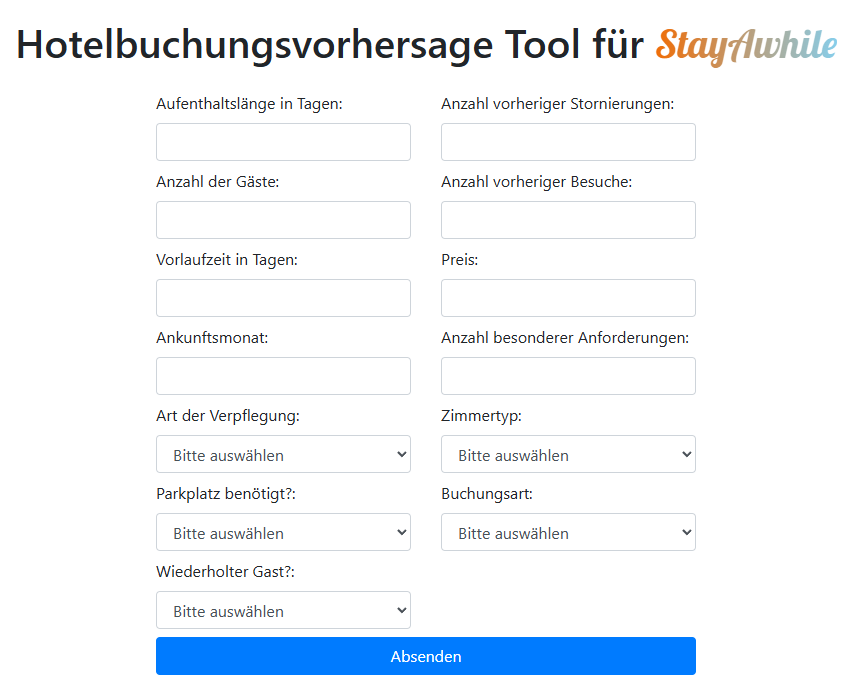
- Interactive Prediction Form: Development of a user-friendly web form that allows hotel staff to input booking details and receive real-time cancellation probability predictions based on the trained model.
- Jupyter Notebook Implementation: Complete analysis and model development documented in an interactive Jupyter Notebook for reproducibility and easy understanding.
Key Features
- Multi-Algorithm Comparison: Systematic evaluation of different machine learning approaches
- Feature Importance Analysis: Identification of the most influential factors in cancellation decisions
- Robust Prediction Model: Random Forest ensemble method for reliable cancellation forecasting
- Interactive Web Form: Real-time prediction interface where users can input guest booking details and instantly receive cancellation probability assessments
- Operational Insights: Actionable predictions to improve hotel revenue management
- Reproducible Analysis: Complete workflow documented in Jupyter Notebook format
Technical Implementation
The project utilizes Python with key libraries including Scikit-learn for machine learning algorithms, Pandas for data manipulation, and Matplotlib/Seaborn for visualization. The Random Forest model demonstrated superior performance by effectively handling the complexity of booking data while providing interpretable results for business decision-making.
The interactive prediction form serves as a practical application of the trained model, allowing hotel staff to input parameters such as lead time, room type, guest demographics, and booking characteristics to receive immediate cancellation risk assessments. This user-friendly interface bridges the gap between complex machine learning models and practical business operations.